Permanent Lighting for a Patio Cover and Pool Home in Orangevale
A real Orangevale project: permanent lighting on a stucco home and a long backyard patio cover beside the pool, with sealed power equipment and a color test before the crew left.
The job: permanent track lighting for Julie on a stucco home in Orangevale, with a gabled front, a taller side wall and a large backyard patio cover beside the pool. The challenge: lighting a lattice style patio cover where the usual roof edge does not exist, and keeping the power equipment dry and out of sight near a pool. The result: track and lights on the home's eaves and gables, plus a line along the outside beam of the patio cover, powered from a weatherproof enclosure and color tested before the crew left.
Have a patio cover or a pool in the backyard?
Free design consultation, transparent pricing, no obligation.
Most permanent lighting jobs start at the front of the house. Julie's started in the backyard. Her pool, her palms and a long aluminum lattice patio cover are where her family actually spends its evenings, so that is where the lighting plan had to work hardest. The front of the house still got the full treatment, but the patio cover is what made this project different.
Here is how the job came together in Orangevale, from the plan we marked up on site to the equipment details that keep a system like this safe around water.
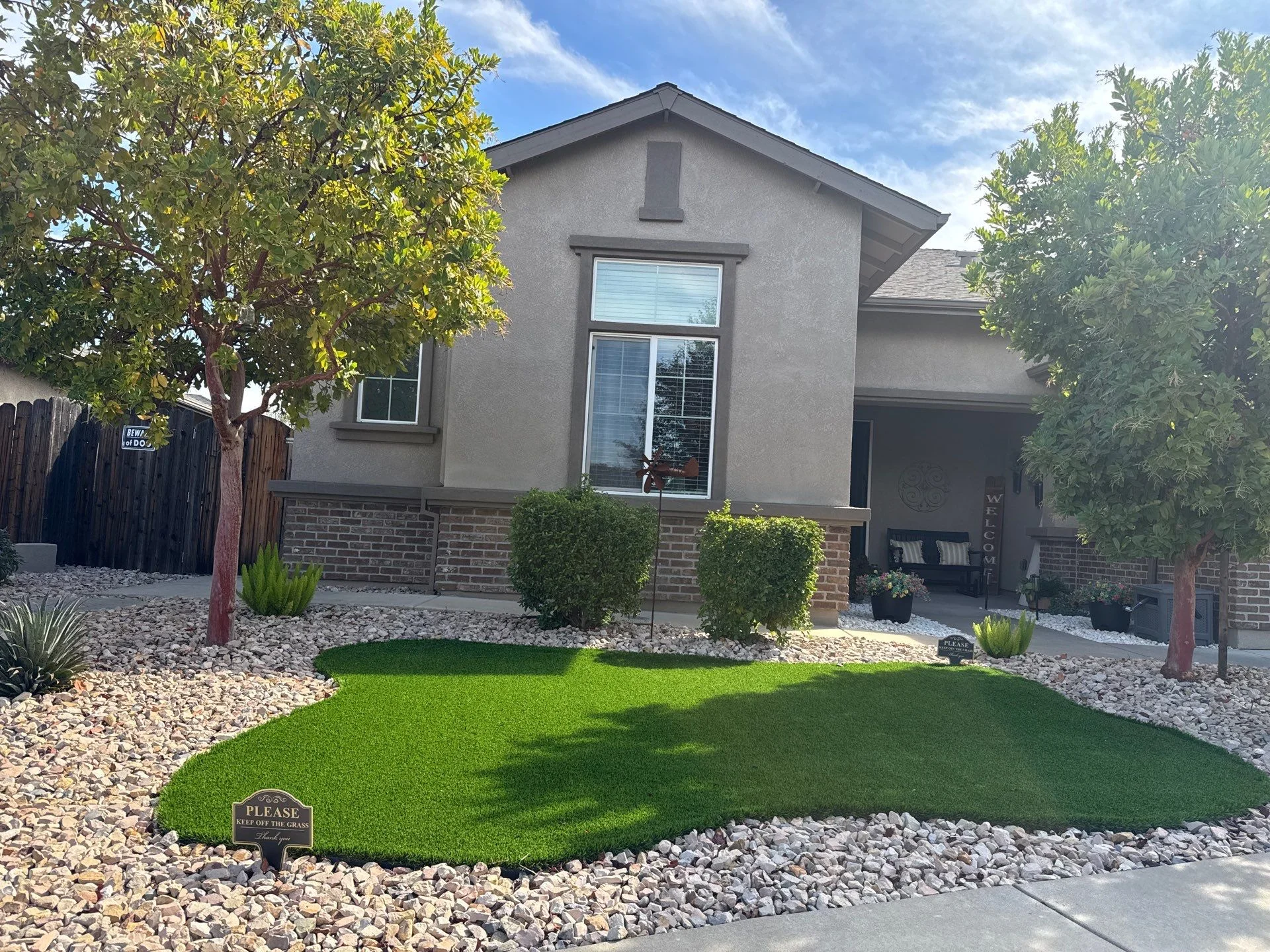
The Home in Orangevale
Orangevale is a community in Sacramento County, in the rolling country between Sacramento and the Sierra foothills. According to Wikipedia's overview of Orangevale, it began as the Orange Vale Colony and was once known for its orange groves, with olive orchards in the area as well. Newer housing now fills the old grove land, but the lots still tend to be generous, and many homes have a pool and a covered patio out back.
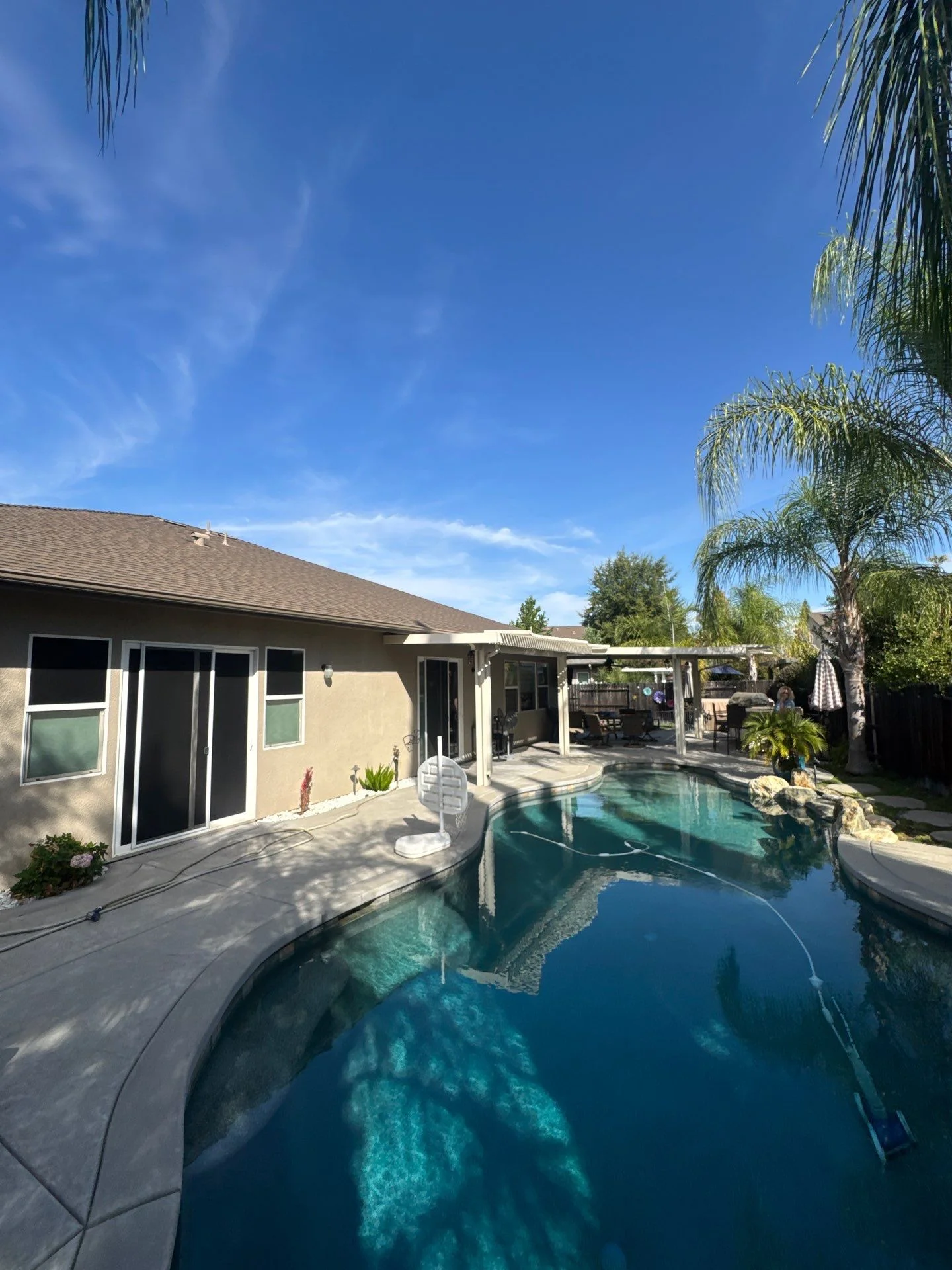
Julie's property is a good example. The front is a stucco house with a brick base, dark trim and a covered entry. The back opens onto a freeform pool framed by queen palms, a rock feature along the far fence, and a long patio cover with seating and a bar area underneath. It is a home designed for entertaining outdoors, and that is exactly the kind of property permanent lighting suits, because the lights are there every evening, not just during the holidays.
That also changes how we plan. A holiday display faces the street. A backyard like this faces the people sitting in it, so the lights need to look good from below, from inside the patio cover and across the water.
Gables, Stucco and a Tall Side Wall
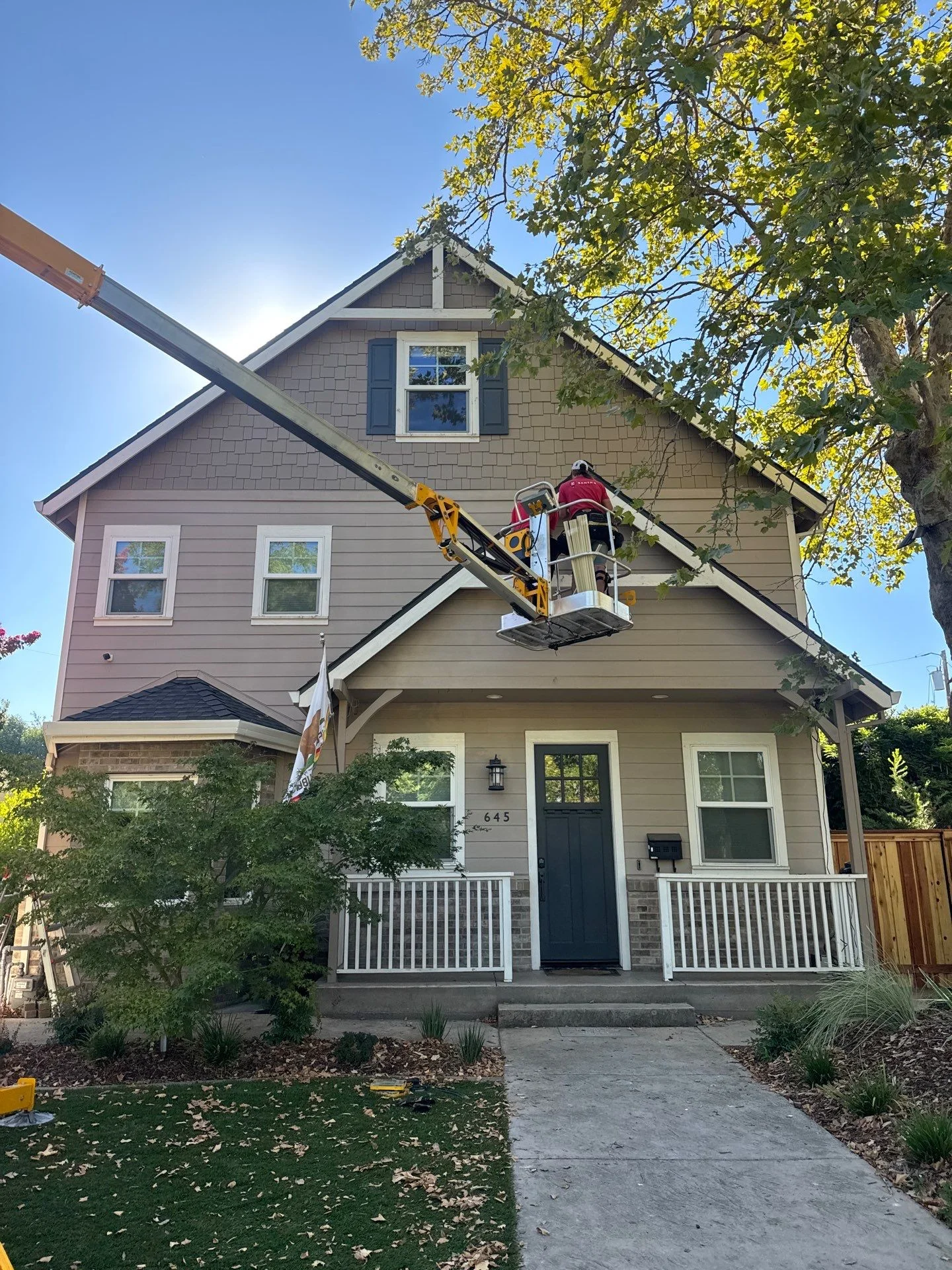
On the front and sides, the work followed the roofline. The photos show a crew member on a ladder at a tall stucco side wall, working along the eave at a gable end, with another crew member footing a second ladder nearby. On stucco homes like this, the clean attachment points are the fascia and the eave, so the track runs along those edges instead of touching the stucco face.
| Area | What the work involved |
|---|---|
| Gable and eave edges | Track mounted along the fascia and eave line, following each roof edge |
| Tall side wall | A taller ladder setup with a second person footing it, since the eave sits well above a single story |
| Corners | Track turned and joined cleanly so the line looks continuous at each corner |
| Rear patio cover | Handled as its own section, with its own plan for where the track mounts |
One thing worth knowing about stucco: it does not take fasteners the way wood trim does, and it is easy to damage. Keeping the track on the roof edge protects the finish and keeps the system easy to service later. Our post on what permanent lights look like during the day shows how little you see of the track once it is up.
Lighting a Lattice Patio Cover
The patio cover is where this job got interesting. It is an aluminum lattice style cover, with a solid section over the seating area and an open slatted section that reaches toward the pool. There is no roof edge to follow, so the crew's plan was marked directly on a photo: install on the outside beam. That beam is the structural edge that frames the cover, and it gives the lights a straight, solid place to mount.
Photos from the day show track running along the beams of the cover, with fixtures lit green and blue as part of the testing. From underneath, the lights sit in a neat row along each beam, which draws the eye along the length of the cover and reflects off the lattice above. At the back, the track follows the curve of the cover as the slats step around it.
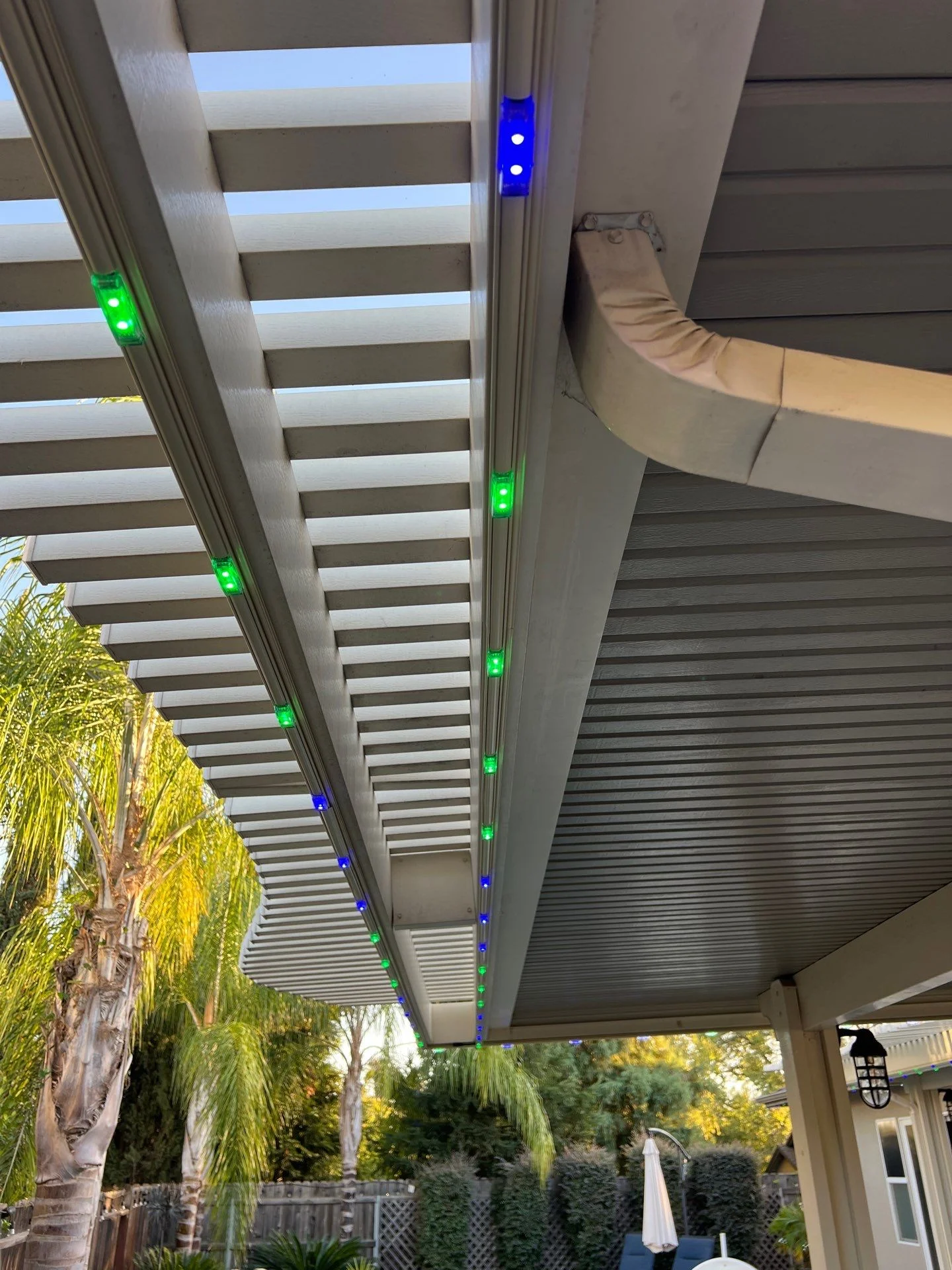
- Mount on the beam, not the slats. The beams are the strongest, straightest lines on the structure, so the track sits flat and stays aligned.
- Plan the route first. The crew marked the beam path on a photo before starting, so the run was clear from end to end.
- Follow the structure. Where the cover curves or steps, the track follows the same shape instead of cutting across it.
- Keep the lights out of the line of sight. Fixtures face down and outward so the glow lights the patio rather than shining into people's eyes.
Planning lights for a patio cover or pergola?
Send us a photo and we will mark up where the track would go.
Matching the Track to the House
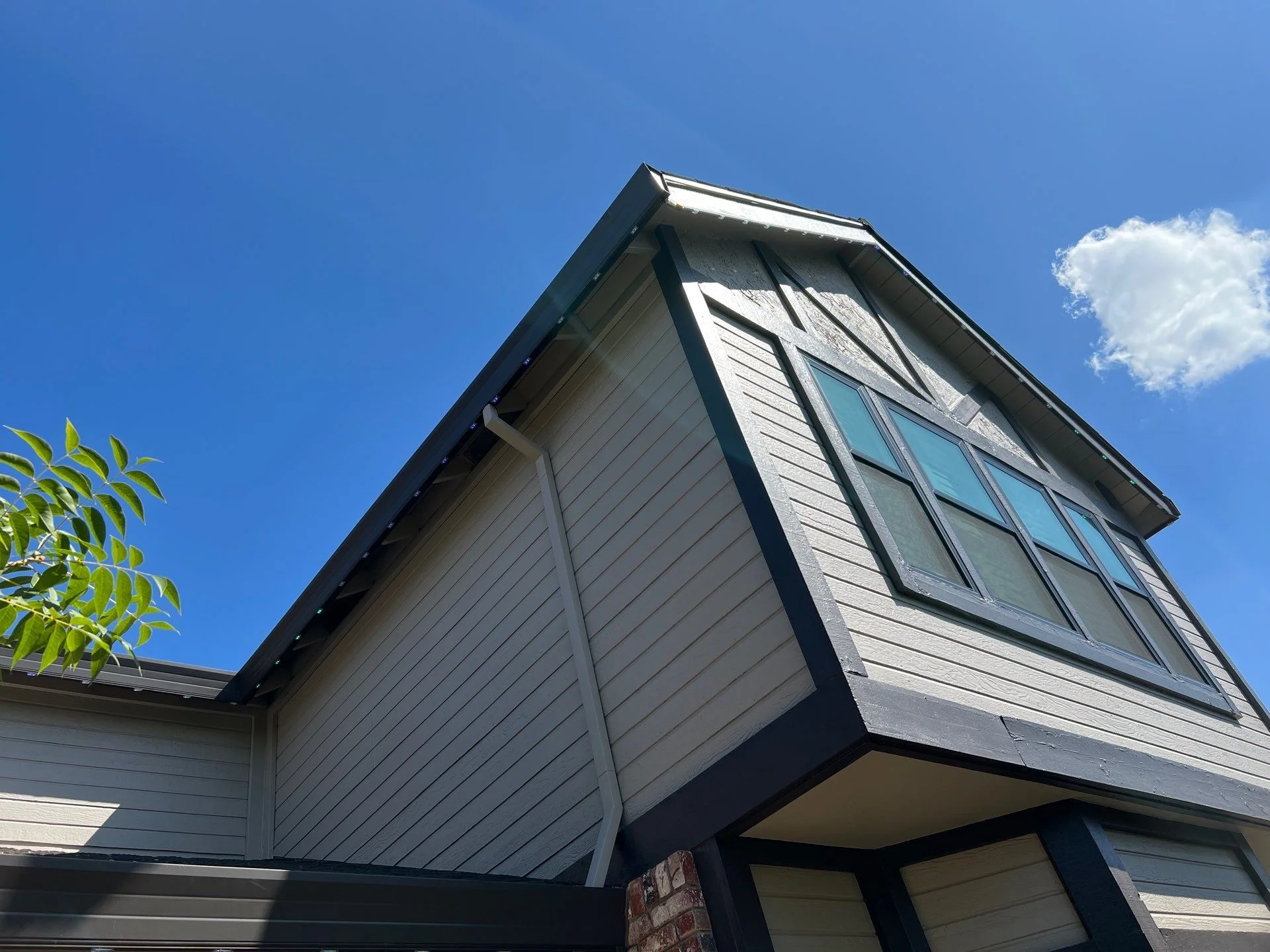
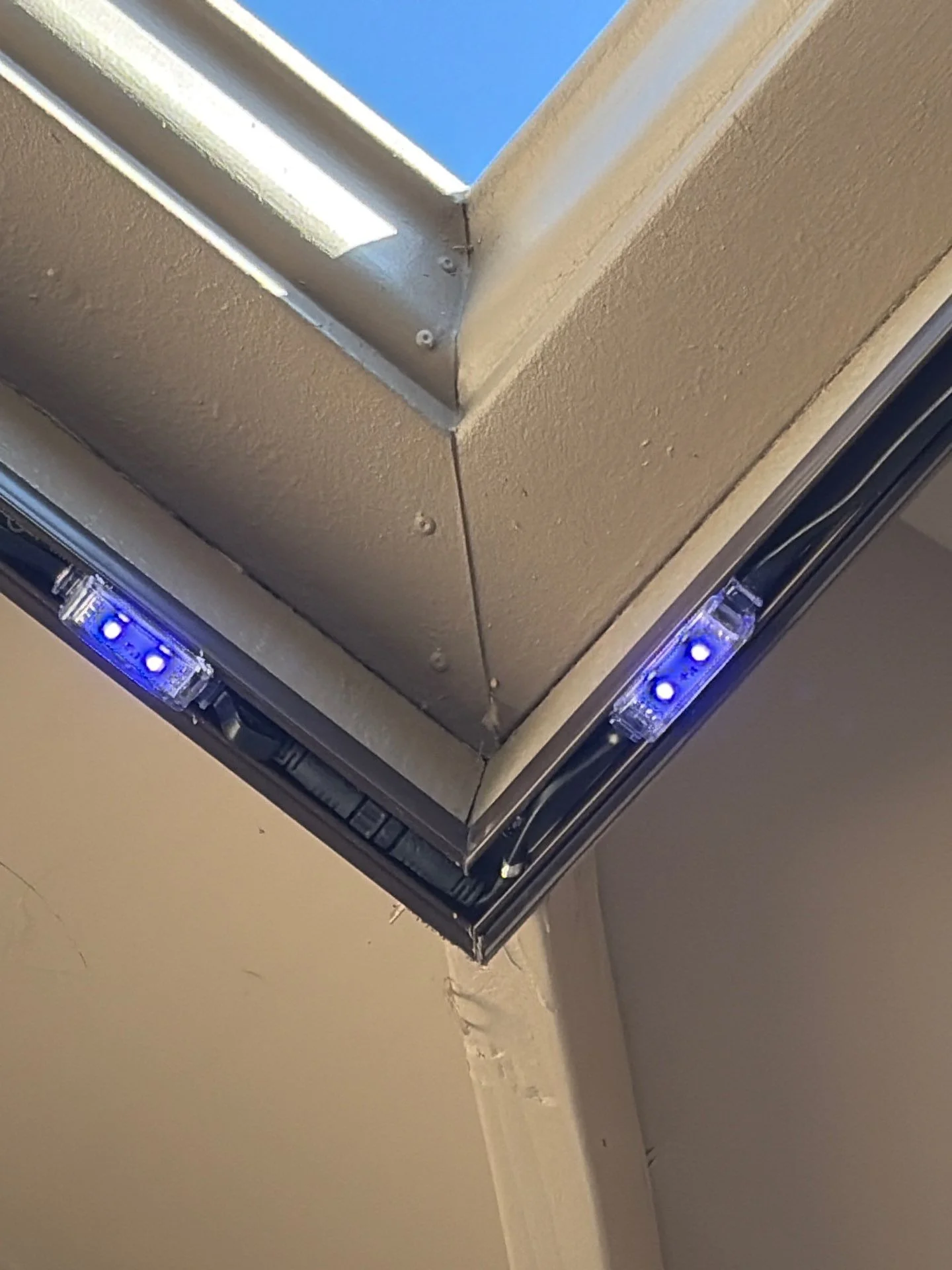
Close-up photos from the corners of the house show a dark brown track running along a brown fascia, mitered neatly where two roof edges meet. The fixtures are small clear pebbles, each holding two diodes, spaced evenly along the track. On the patio cover, the track is a lighter cream that blends into the pale beams.
That matching is deliberate. Track comes in several colors, including white, sand, light brown, dark brown, black and gray, so it can disappear against whatever surface it sits on. A house with brown trim gets brown track. A cream patio cover gets cream. Done well, the system is nearly invisible in daylight, and the lights only show up when they are switched on.
| Surface | Track color approach |
|---|---|
| Brown fascia and eaves | Dark brown track so it blends into the trim |
| Cream patio cover beams | A lighter track color that matches the beam |
| White trim | White track, which disappears against the paint |
| Mixed finishes | Different track colors by section, chosen to match each surface |
Power Near a Pool
The power equipment is the most important part of any permanent system, and on a property with a pool it deserves extra care. One photo shows the power supply and controller mounted in a weatherproof enclosure on the stucco wall, with a hinged cover, a gasket seal, sealed plug-in connectors and a green status light showing that it is powered up. Everything is contained, labeled and easy to reach for service.
The location matters as much as the box. Equipment like this belongs in a sheltered spot, off the ground and well away from splashing and standing water. The Electrical Safety Foundation International advises using equipment marked for outdoor use, plugging outdoor lighting into ground fault circuit interrupter protected outlets, and keeping cords clear of standing water. Those principles apply even more strongly in a backyard with a pool.
- Weatherproof enclosure. A sealed box with a gasket keeps rain, sprinklers and pool splash off the electronics.
- Sealed connectors. Plug-in connectors with locking, waterproof fittings, rather than loose wire nuts or open splices.
- Away from the water. Mounted high on a wall in a sheltered spot, not near the pool edge.
- Easy to service. A hinged cover and a status light make it simple to check without taking anything apart.
Good to know: a quality power setup is a big part of what separates systems. Our post on why Minleon is the gold standard explains what to look for in track, fixtures and controllers.
The Color Test
Several photos show the lights glowing blue and green in the middle of the afternoon. That is the commissioning step. Before the crew leaves, we power the system on and cycle through colors to confirm every fixture along every run is responding. If one is out or loose, we want to find it while the ladders are still up.
It also shows what the system can do. Permanent lights are individually addressable, so each fixture can show its own color. That means warm white for everyday evenings, team colors on a game day or a holiday scheme in December, all from the same hardware. If you want the details, our guide on whether Christmas lights can change colors covers the options.
Why a Backyard Changes the Design
A front roofline is judged from the street, at a distance, in a few seconds as someone drives by. A backyard is judged up close and for hours. People sit under the patio cover, swim in the pool, cook at the bar and look up at the lights from just a few feet away. That changes almost every design decision we make.
| Design question | Front of the house | Backyard and patio |
|---|---|---|
| Viewing distance | Far, from the street or driveway | Close, from a seat or the pool |
| Brightness | Bright enough to read from across the road | Softer, so it flatters people and does not glare |
| Color use | Often one steady warm white | Warm white for dinner, color for parties and holidays |
| What shows | The outline of the roof | The shape of the structure and its reflection on the water |
That is why we think about fixture spacing and brightness differently in a space like Julie's. A row of lights that looks great from the sidewalk can feel harsh from three feet away, so the backyard run is set up to be easy on the eyes. Reflections matter too. With a pool beside the patio cover, the lights double in the water, which adds to the effect without adding a single fixture.
It also affects planning for the long term. Because a permanent system is always on the house, the backyard section tends to get used the most, for birthdays, barbecues and quiet evenings. We encourage homeowners to think about how they live outdoors before choosing which sections to light first.
Questions to Ask Before You Book
Backyard and patio projects have details that are easy to overlook at the quote stage. These are the questions we encourage homeowners to ask any installer.
| Question | What a good answer sounds like |
|---|---|
| Where will the track mount on my patio cover? | A specific beam or edge, marked on a photo of your own structure |
| Where does the power supply go? | A sheltered, off-the-ground spot, away from the pool and the sprinklers |
| Is the equipment weatherproof? | A sealed enclosure with waterproof connectors, not an open box or loose splices |
| Will the track match my trim? | A color chosen for each surface and confirmed with you before install |
| Who do I call if something stops working? | A local company that answers its phone and returns to fix it |
If your quote leaves any of those unanswered, ask for the answers in writing. Our permanent lighting cost guide also explains how scope and complexity affect the price, so you know what to expect before you compare quotes.
"Great experience year after year. If anything comes loose, Clark comes right away to fix it, and he schedules takedown way ahead of time, which is so convenient."
Kelley Kalin, Google Review, Sacramento Area HomeownerSafety and Electrical Basics
A tall stucco wall and a gable end are exactly where falls happen. The U.S. Consumer Product Safety Commission estimates that holiday decorating has sent 12,000 or more people to emergency departments every year since 2009, and falls were the most frequently reported incident. A permanent system changes the equation: it goes up once, with a trained crew, and you never climb a ladder to hang lights again.
Efficiency matters too. ENERGY STAR reports that certified LED decorative light strings use about 92 percent less energy than incandescent strings, and that same LED efficiency is what makes it practical to leave a system installed all year. For taller jobs, our post on when a job needs scaffolding or a lift explains the equipment side.
The Finished Result
When the crew wrapped up, Julie's home had a continuous line along its eaves and gables and a second line running the length of the patio cover. In the evening, the patio glows warm over the seating area and the pool, and the front of the house has a clean, even outline. In daylight, the track fades into the trim.
That is the real measure of a backyard lighting job. It should make the space more inviting at night and be almost invisible the rest of the time. When the planning is done properly, it is.
Good to know: permanent lighting of $4,000 or more also qualifies you for free Christmas lights this year, a $799 value, through our current offer. Financing is available with a soft credit pull, with payments as low as $150 a month.
Want to see it on your own patio?
Try our AI Visualizer, completely free.
FAQ: Permanent Lighting for Patio Covers and Pool Homes, Answered
Can permanent lighting go on an aluminum lattice patio cover?
Yes. The track mounts on the outside beam of the cover, which gives it a straight, solid line, and the track color is matched to the beam.
Is it safe to install lights near a pool?
Yes, when the equipment is weatherproof, mounted away from the water and plugged into GFCI protected power. We plan the power location before any lights go up.
Where does the power supply go?
In a sheltered spot on a wall, off the ground and away from splash and sprinklers, inside a sealed enclosure.
Will you see the track during the day?
We match the track color to your trim, so on most homes it is hard to notice from the yard or the street.
Does stucco get damaged by the install?
The track mounts at the eave and fascia, not on the stucco face, so the finish is left alone.
Why were the lights glowing blue and green in the afternoon?
That is the color test. We cycle through colors before leaving to confirm every fixture is working.
Can I use different colors for different occasions?
Yes. Each fixture is individually addressable, so one system can show warm white, team colors or holiday colors.
How much does it cost?
It depends on the length and complexity of the roofline and any extra structures. Our cost guide explains the factors, see our typical costs page for ranges, and a free quote gives you an exact number.
Do you serve Orangevale?
Yes. Orangevale and the surrounding Sacramento area are part of our service area.
More real Santa's Lights projects: see how we handled similar jobs, or browse our permanent lighting page and our photo gallery.
Backyards are where a lot of us actually live, and lighting them well is worth the planning. A good system sits quietly on the structure, stays dry, matches your trim and makes the evenings better. That is what we aim for on every job.
Clark, Santa's Lights

Clark started Santa's Lights back in 2014 with a ladder, a truck, and way too much confidence in his own knot tying. Since then he's lit up thousands of homes across Sacramento, Loomis, Folsom, and beyond, and he still shows up to jobs himself often enough to know exactly what he's talking about. When he's not on a roofline, he's probably answering your call directly, because that's still how this business works.