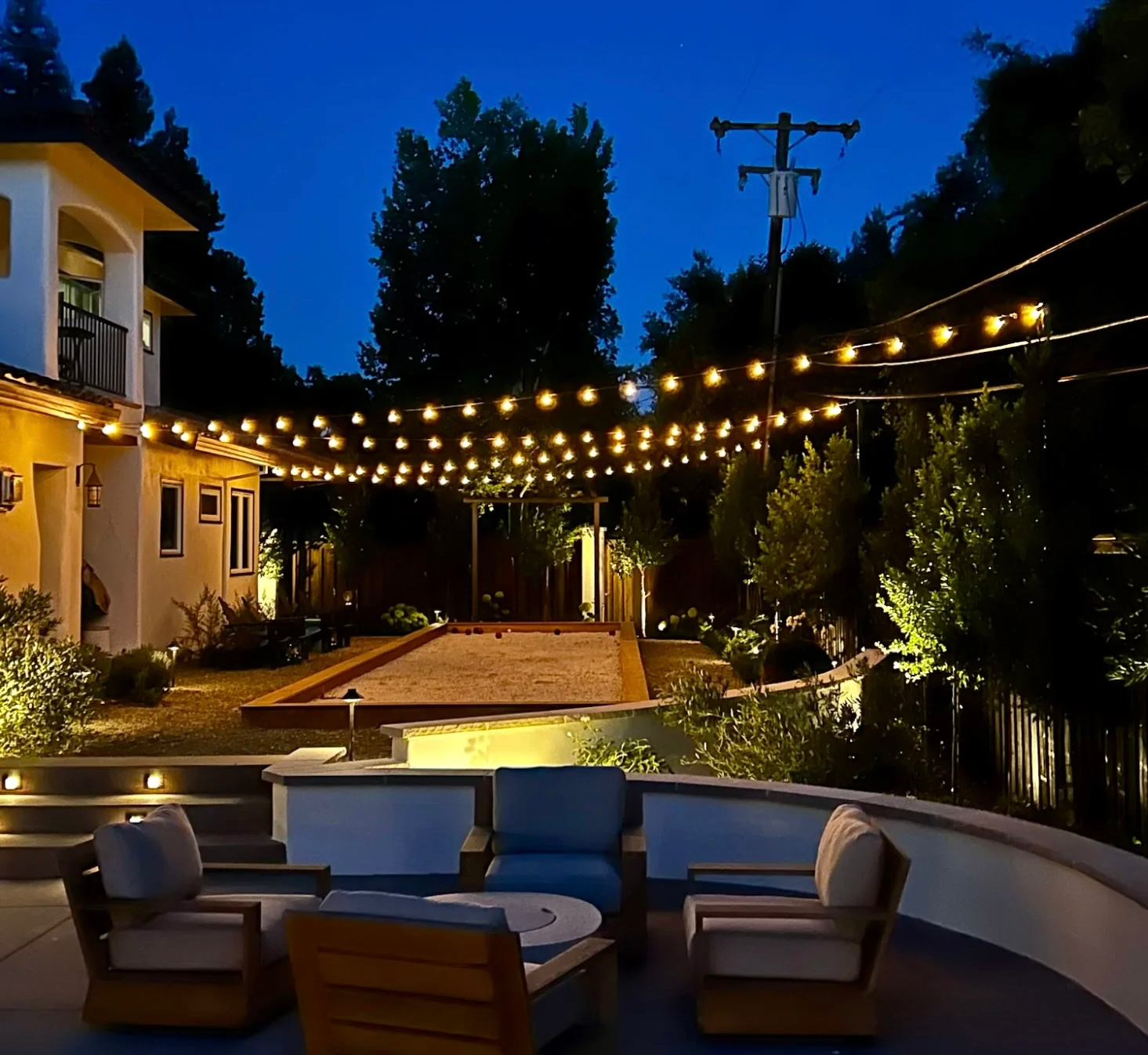
Bistro String Lights Over a Backyard Bocce Court in Fair Oaks
A Fair Oaks homeowner wanted her bocce court lit for evening games. Here is how we anchored, spaced and layered the string lights, and what to ask any installer before you book.
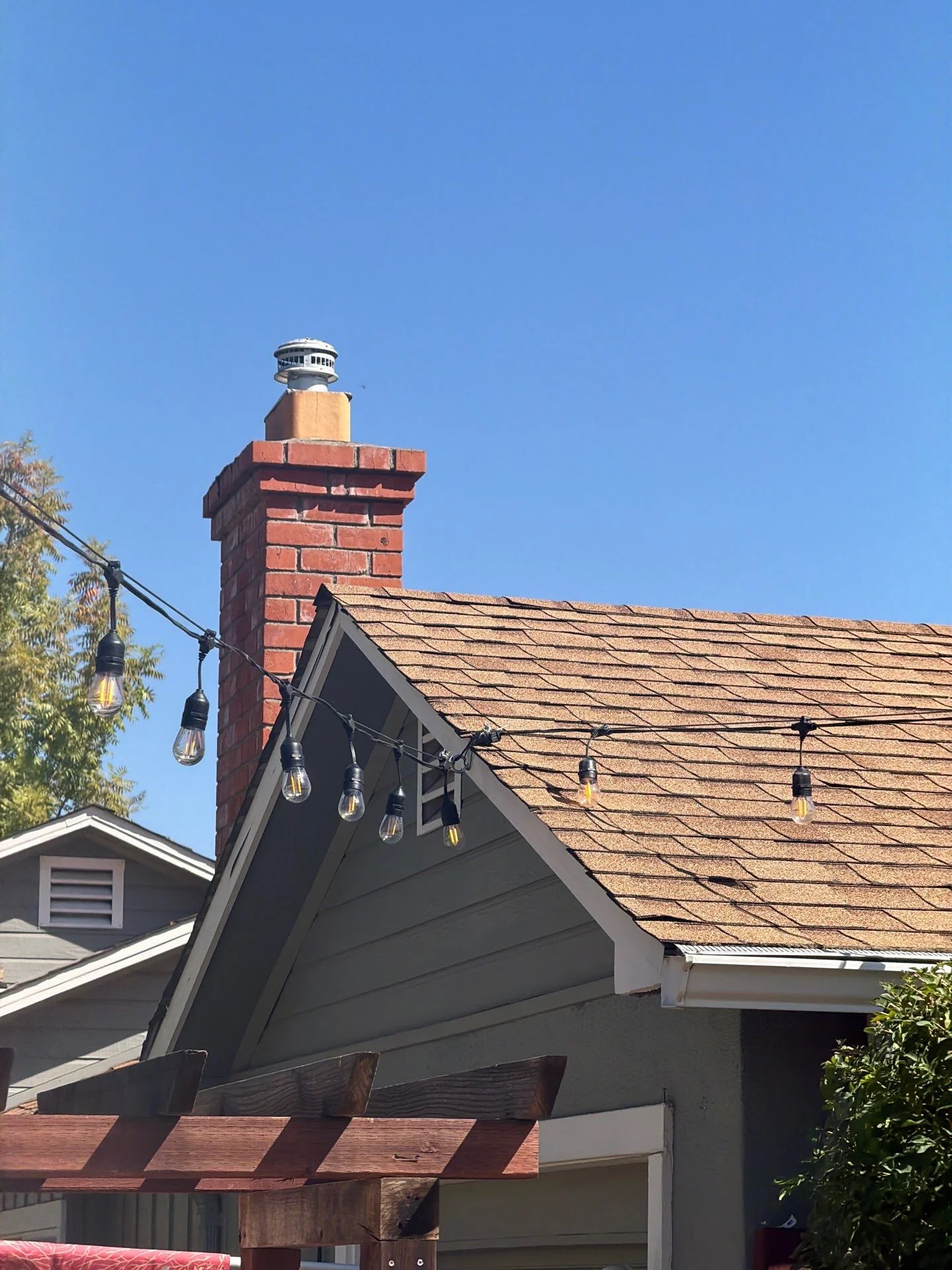
The job: commercial grade bistro string lights over a backyard bocce court for Leslie in Fair Oaks, with multiple runs anchored to the garage roofline, posts and trees. The challenge: hanging long, evenly sagging strings over open space with no ceiling to hang from, while keeping every run anchored securely and powered safely. The result: four layered strings of warm filament style bulbs crossing the court, installed by a three-person crew in a single day, with a very happy homeowner on the red carpet at the end.
Want bistro lights over your patio, court or garden?
Free design consultation, transparent pricing, no obligation.
Most homeowners picture Christmas lights on the roof. Leslie wanted something that would be used every week of the year: warm string lights over her backyard bocce court, so an evening game could turn into a long, easy night outside. It is one of the best uses of bistro lighting we install, and this job shows what goes into getting it right.
Here is how the project came together in Fair Oaks, from finding anchor points over open ground to the small spacing decisions that make a string look relaxed instead of sloppy.
A Backyard Built for Bocce
Fair Oaks sits between Sacramento and Folsom, with the American River along its southern edge. According to Wikipedia's overview of Fair Oaks, it is known for lush, tree covered streets and a semi-rural feel, with a mix of custom-home pockets. Many yards here are generous, mature and full of character, which makes them ideal for outdoor living.
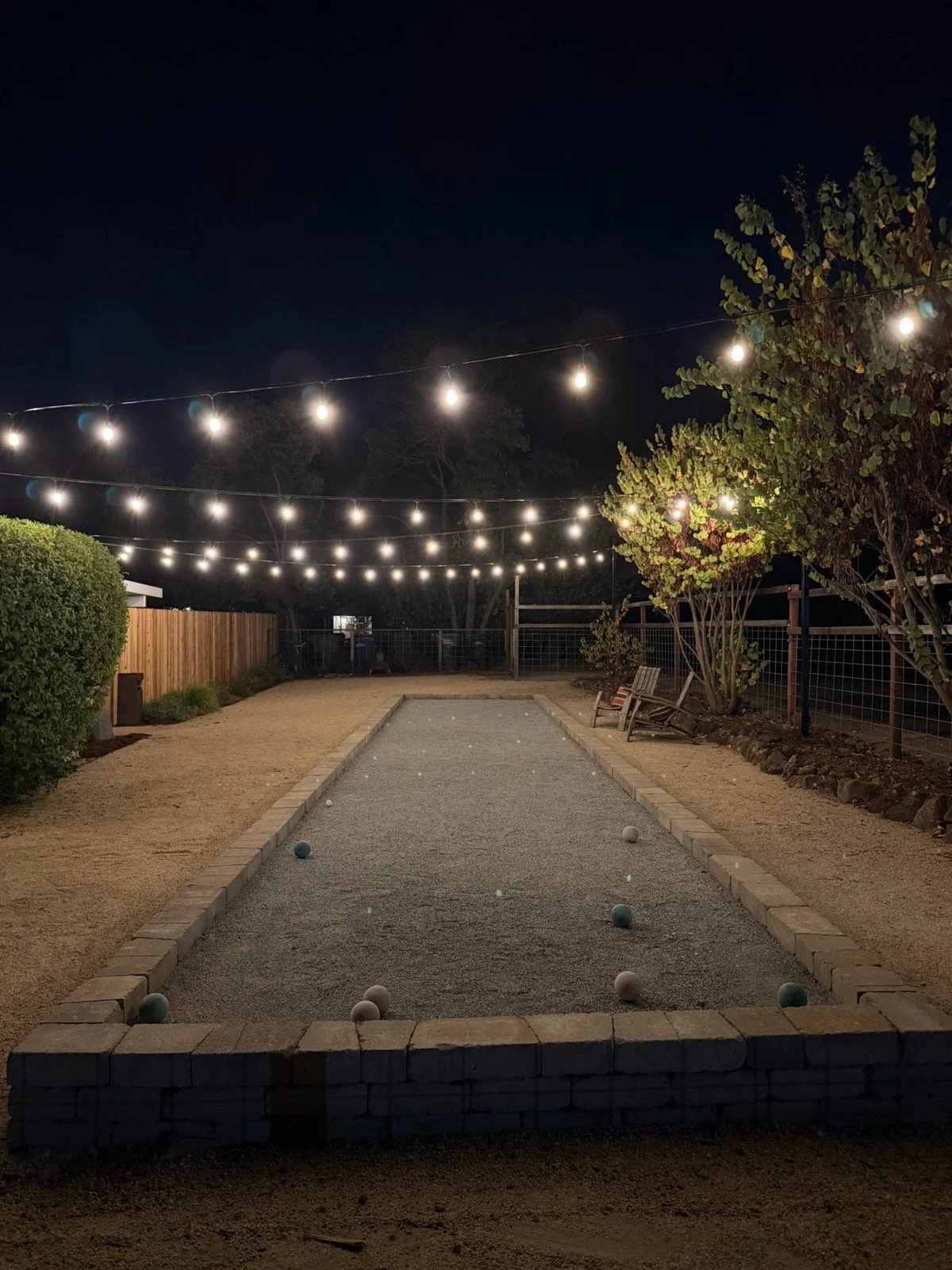
Leslie's yard is a good example. A regulation style bocce court runs down the middle, finished in fine crushed stone and edged with a neat paver border. Decomposed granite paths run along both sides, there is a pair of Adirondack chairs near the fence, hog wire fencing with timber posts along the back, a trimmed hedge, and a simple pergola near the garage. A covered patio sits at the back of the house. It is a yard designed for spending time in.
That is what makes lighting it interesting. A court is a large, open rectangle with nothing overhead, so the lights have to be suspended across the space, and everything depends on where the strings can be anchored.
Finding Anchor Points Over Open Space
Bistro strings are only as good as their anchors. Each run needs a strong point at both ends, and those points have to hold the string's weight, stay put through wind and weather, and sit at the right height. On this job the crew used a mix of structures already in the yard.
| Anchor point | How it was used |
|---|---|
| Garage roofline | Strings run from the roof edge, with the cord secured at the fascia so it holds without touching the shingles more than necessary |
| Timber posts along the fence | Strong, fixed points that keep the far ends of each run at a consistent height |
| Mature trees | Used where a tree is the natural anchor, with care taken so nothing cuts into the bark |
| Pergola | A sturdy overhead structure near the garage that gives the run a clean starting point |
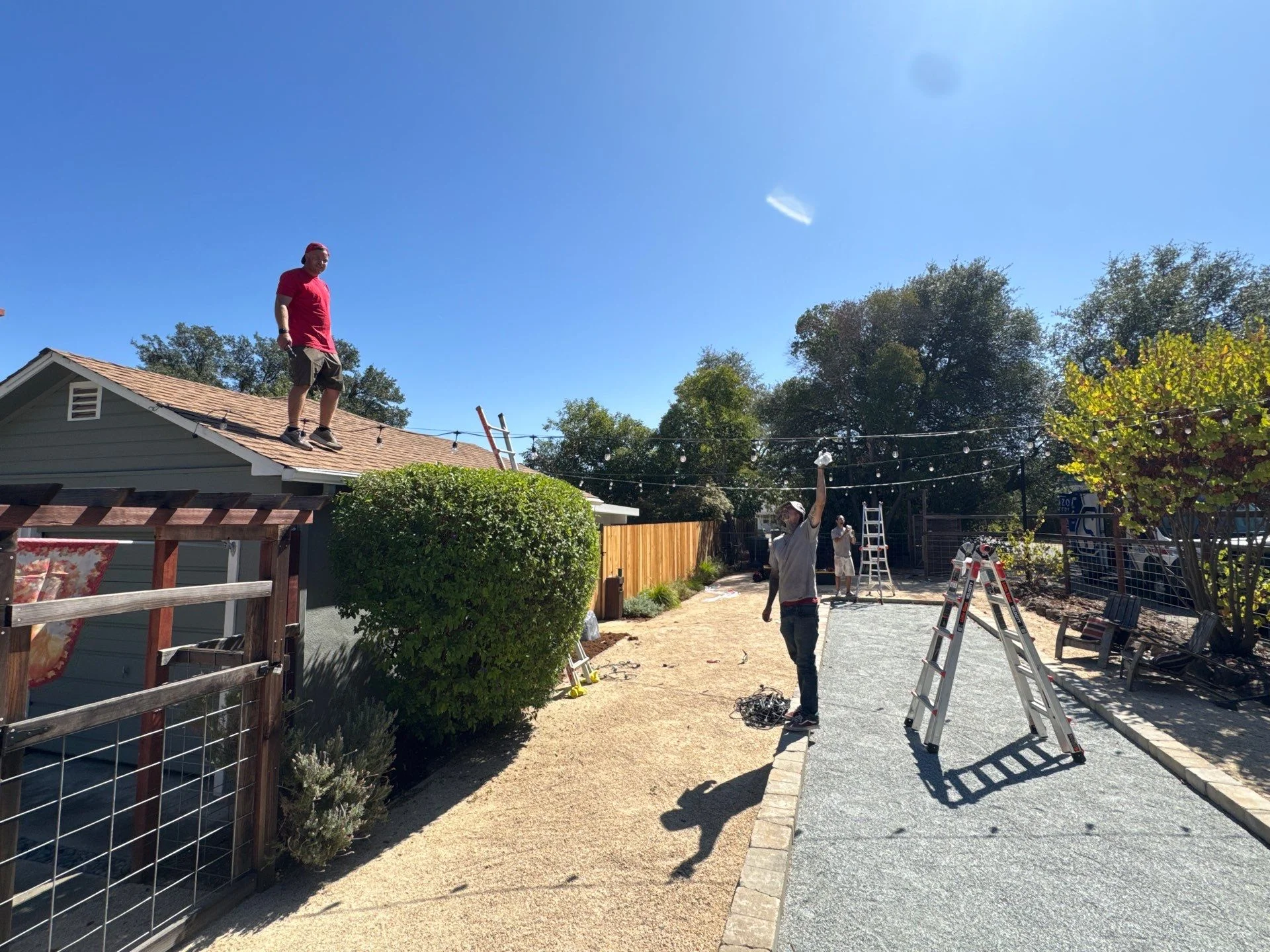
Photos from the day show a crew member standing on the garage roof, passing the cord toward the next anchor, while a second person on the ground feeds the line across the court. A third works from a ladder at the far end. It is a simple choreography, but it only works if everyone knows where each run starts and stops.
- Plan every anchor first. We walk the yard before any cord goes up, so each run has a start and an end that make sense.
- Use strong structures. Posts, fascia and sturdy beams, never a branch that moves or a fence board that could pull loose.
- Match the heights. Anchors at similar heights make the strings look intentional instead of lopsided.
- Protect what they touch. Roofs, trees and posts are left undamaged so the lights can come down cleanly later.
Not sure where lights could hang in your yard?
Send us a photo and we will mark up the anchor points for you.
Spacing, Sag and Layered Runs
The night photo shows the part of the job that is easy to overlook: the strings are layered. There are four runs crossing the court at slightly different heights, and the bulbs on each run are evenly spaced. Seen from the end of the court, they look like a canopy of soft points of light, each row sitting just above the next.
That look comes from three decisions. The first is spacing between bulbs. Close enough to look full, far enough apart that each bulb has its own glow. The second is sag. A gentle, even curve between anchors looks natural. A taut, straight line looks stiff, and a deep droop looks sloppy. The third is the layering itself. Offsetting the runs gives depth, so the yard feels covered without feeling crowded.
| Decision | What good looks like |
|---|---|
| Bulb spacing | Even, with a full look from a distance and a clear glow around each bulb |
| Sag | A gentle curve, consistent from one run to the next |
| Layer heights | Runs offset slightly so the canopy has depth |
| Clearance | High enough that nobody can reach up and touch a bulb, even while tossing a bocce ball |
If your yard is smaller, one or two runs may be all you need. A court like this one, around ten feet wide and long enough for a full game, can carry several. Our post on commercial bistro and patio lighting in Sacramento looks at how the same ideas scale from a restaurant patio down to a home.
Bulbs, Warmth and Brightness
The bulbs in these photos are large, teardrop style LED bulbs with visible filaments, hanging from black cord on small weatherproof sockets. In daylight they look like classic vintage bulbs. At night they give off a warm, amber toned light that feels more like candlelight than a lamp.
That warmth is deliberate. For a place where people gather, a warm color temperature flatters faces, softens the surroundings and keeps the mood relaxed. Cooler, bluer light tends to feel clinical outdoors. If you want to understand the choices, our color temperature and bulb style guide explains how to choose.
Efficiency matters because bistro lights are meant to stay up and be used. ENERGY STAR reports that certified LED decorative light strings use about 92 percent less energy than incandescent strings, which is why LED is the practical choice for lights you will switch on most evenings. For a home with a bocce court, that can mean hours of light for very little power.
Power and Weather
Strings like these are built for the outdoors, with sealed sockets and weather rated cord, but the power side still needs planning. Each run is sized for the load, and the whole system is plugged into a protected outlet. The Electrical Safety Foundation International advises using equipment marked for outdoor use, plugging outdoor lighting into ground fault circuit interrupter protected outlets, and keeping cords clear of standing water. All of that applies to a backyard.
- Weather rated strings. Sealed sockets and rugged cord made for continuous outdoor use.
- Protected power. Plugged into GFCI protected outlets, with a portable GFCI where needed.
- Planned cord routes. Power cords run along fences and edges, away from foot traffic and away from standing water.
- A simple way to switch them on. A plug in timer or switch makes it easy to turn the lights on at dusk and off at bedtime.
Good to know: bistro lighting is one of our year-round services, not just a holiday one. See our bistro lighting service and our post on designing unforgettable event lighting for ideas on weddings, parties and everyday evenings.
Three People, One Afternoon
This was a three-person job: one on the garage roof, one on the ground feeding and positioning the line, and one on a ladder at the far anchor points. Working as a team kept each run moving and let the crew check the sag from the ground while the next run was going up.
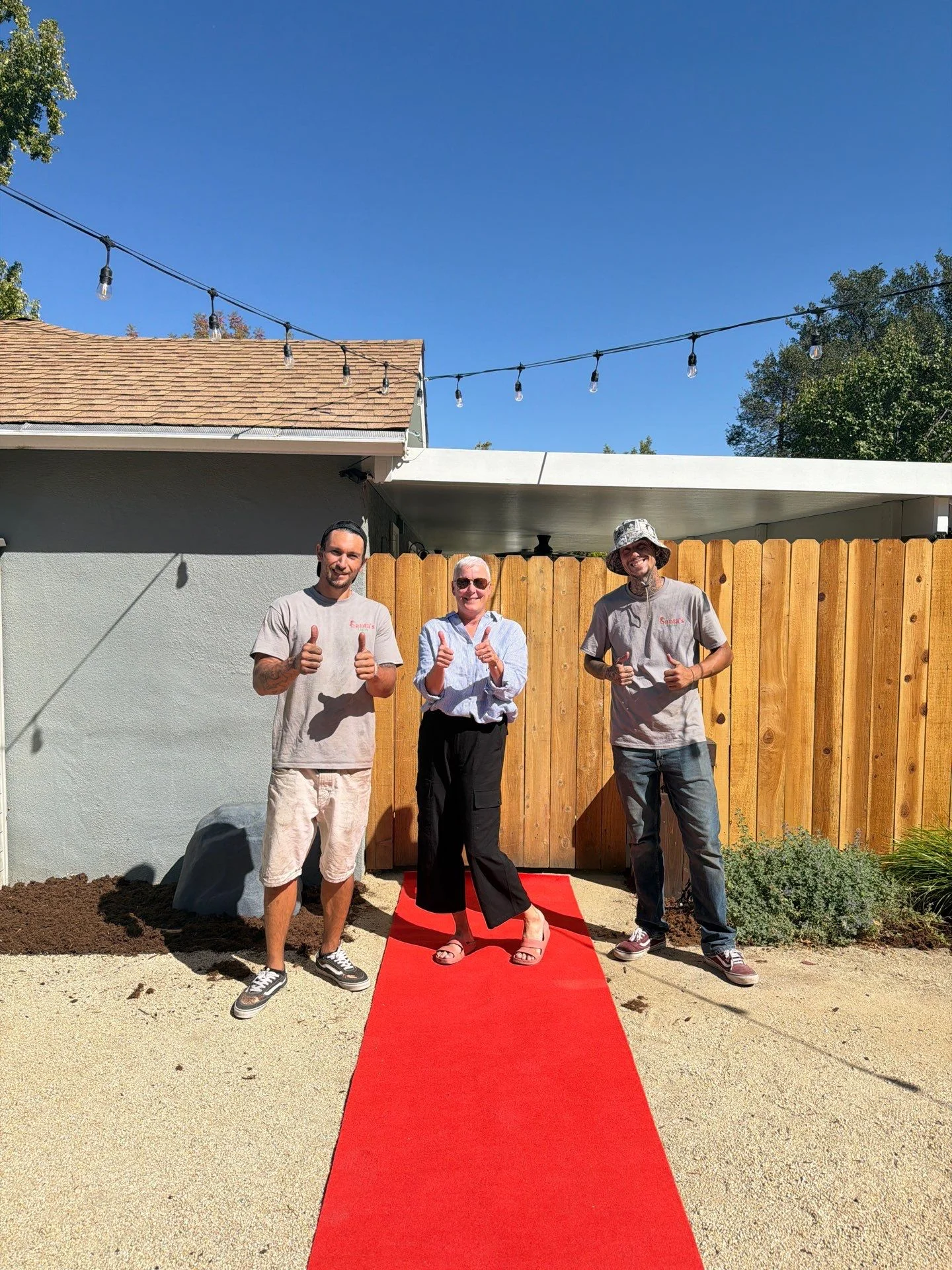
The end of the day is our favorite part. The final photo shows two crew members and Leslie standing together on a red carpet, all giving thumbs up, with a row of bulbs strung overhead behind them. We roll out the carpet for the finish of installs, and Leslie was clearly delighted with how the yard turned out.
"Great experience year after year. If anything comes loose, Clark comes right away to fix it, and he schedules takedown way ahead of time, which is so convenient."
Kelley Kalin, Google Review, Sacramento Area HomeownerBeyond the Bocce Court: Where Else Bistro Lights Work
A bocce court is a fun example, but the same approach works across a wide range of outdoor spaces. The tools are the same: strong anchors, even spacing, a gentle sag and warm bulbs. What changes is the layout, and the way people use the space.
| Space | How bistro lights suit it | Typical layout |
|---|---|---|
| Backyard court or lawn | Lights the whole play area without a single pole in the way | Several layered runs between posts, fascia and trees |
| Covered patio or pergola | Adds a warm glow over dining and seating | One or two runs along or across the structure |
| Pool area | Creates a soft glow that reflects in the water | Runs set well above and clear of the water |
| Garden path and gathering area | Marks the way and makes the space feel welcoming | Lower runs on posts, with enough clearance for guests |
| Event and party space | Turns a plain yard into a venue for a night | Temporary or permanent runs planned around the guest layout |
Some customers use the same strings for the holidays too. Bistro bulbs look great in winter, and a yard that is already lit makes it easy to add a wreath or a tree wrap. If you want a system that goes further, such as roofline lighting that changes color, take a look at our permanent lighting options, and our guide on timers and automation explains how to switch lights on and off without thinking about it.
Whatever the space, the first step is the same: walk the yard at dusk and notice where people naturally gather. Those spots are where the light should go. A good installer will ask where you spend your time before talking about bulbs, and the best layouts come from that conversation, not from a catalog.
Questions to Ask Before You Book
Bistro lighting looks simple, and that is why it is easy to get wrong. These are the questions we encourage every homeowner to ask any installer.
| Question | What a good answer sounds like |
|---|---|
| Where will each string be anchored? | A specific structure for every end, such as a post, fascia or beam, not a branch or a loose fence board |
| How will the lights be spaced and layered? | A plan for bulb spacing and run heights, ideally shown on a photo of your yard |
| Are the strings rated for outdoor use? | Commercial grade strings with sealed sockets, not indoor strings |
| How will it be powered? | A protected outlet, a planned cord route and a simple switch or timer |
| Who fixes it if something fails? | A local company that returns to repair and replace bulbs when needed |
If you are comparing options, our pages on typical costs, financing and packages show what to expect before you request a quote.
Safety and Electrical Basics
Hanging strings over open space means ladders, roofs and long reaches, which is where injuries happen. The U.S. Consumer Product Safety Commission estimates that holiday decorating has sent 12,000 or more people to emergency departments every year since 2009, and falls were the most frequently reported incident. A trained crew with the right ladders and a second person footing each one makes a big difference.
For taller jobs, our post on when you need scaffolding for a light installation covers the equipment side. And if you want to see more of our backyard and patio work, browse the photo gallery.
The Finished Result
By the end of the day, Leslie's bocce court was covered by four layers of warm bistro lights. At night, the strings glow over the court, the paver border and the chairs, and you can see the lights reflected in the trees along the fence. During the day, the black cord disappears against the sky, with the bulbs hanging like small glass ornaments.
This is the kind of project that changes how a yard gets used. Once the lights are up, an evening game, a family dinner or a quiet glass of wine on the patio all feel a little more special. That is what a good lighting plan does: it makes the space you already love work later into the night.
More real Santa's Lights projects: see how we handled similar jobs, or browse our bistro lighting service and our photo gallery.
Want to see string lights over your own yard?
Try our AI Visualizer, completely free.
FAQ: Bistro String Lights for Backyards, Answered
Can you hang string lights over a bocce court or open yard?
Yes. We plan anchor points on posts, rooflines, pergolas and sturdy trees, then run layered strings between them at consistent heights.
What do you attach the strings to?
Strong, fixed structures such as fascia, timber posts, beams and pergolas. We avoid anything that moves or could pull loose.
How many strings does a yard need?
It depends on the size of the space. A small patio may need one or two runs, while a larger court can carry several layered runs.
Will the lights damage my roof or trees?
No. We secure the cord at the fascia and use anchors that protect the roof and the trees, so everything can come down cleanly later.
What color are the bulbs?
We use warm, amber toned LED bulbs with a filament look, which flatter people and make the space feel relaxed.
Are bistro lights safe in the rain?
Commercial grade strings with sealed sockets are made for outdoor use, and we plug them into GFCI protected outlets.
Can I leave them up all year?
Yes. Many customers enjoy them year-round, and we can maintain them and replace bulbs when needed.
How much does it cost?
It depends on the number of runs and the anchor setup. See our typical costs page for ranges, or request a free quote for an exact number.
Do you serve Fair Oaks?
Yes. Fair Oaks and the surrounding Sacramento area are part of our service area, and you can see our Fair Oaks lighting page for more.
Backyards are where we spend our best evenings, and lighting them well is one of the nicest things we do. Good anchors, even spacing and warm bulbs are what turn a simple string into a space people want to stay in. That is the goal on every job.
Clark, Santa's Lights

Clark started Santa's Lights back in 2014 with a ladder, a truck, and way too much confidence in his own knot tying. Since then he's lit up thousands of homes across Sacramento, Loomis, Folsom, and beyond, and he still shows up to jobs himself often enough to know exactly what he's talking about. When he's not on a roofline, he's probably answering your call directly, because that's still how this business works.